
What happened when we stopped talking about the photograph long enough to discover what was actually holding it together.
There was already a photograph before the crow arrived.
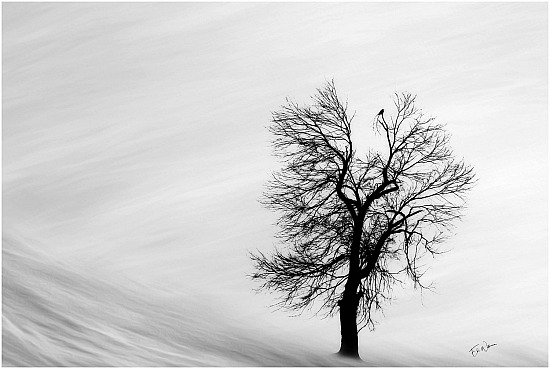
A tree stood dark against an open field and pale sky. That relationship had caught my attention, and I was already working with the composition when a crow landed in the tree.
I couldn't have planned it.
But I could recognize what it gave me.
That small arrival became important later—not because the photograph suddenly became about a crow, but because the crow seemed to reinforce something that was already happening within the image.
That distinction would eventually become part of what this photograph taught me.
Starting With the Photograph
By the time we reached this image in the caption-writing process, we had learned not to begin by looking for a clever title.
We began with the photograph itself.
Where does the eye go?
What holds it?
What is moving?
What isn't?
The dark tree anchors the composition against a much lighter field and sky. Its branches reach into an expanse of pale negative space. Other marks within the landscape suggest movement across the frame.
And then there is the crow.
Small.
Dark.
Still.
It would have been very easy to make the bird the subject simply because it is recognizable.
But the more we looked, the clearer it became that the photograph wasn't really about the crow.
The crow had entered a photograph that was already about relationships.
Finding the Right Word
At one point in our discussion, the word illusion appeared.
I stopped it.
That wasn't what I was trying to create.
The word I wanted was juxtaposition.
That correction mattered more than it might seem.
An illusion asks the viewer to mistake one thing for another.
That wasn't happening here.
What interested me were opposing conditions occupying the same photograph:
light and dark
movement and stillness
The photograph did not depend on hiding those differences.
It depended on putting them together.
Sometimes one word can change the entire conversation.
This was one of those times.
The Space Wasn't Empty
The composition also helped us reconsider something we had encountered in other photographs: negative space.
It is easy to describe the pale area surrounding the tree as empty.
But it isn't.
Without that space, the tree would not feel as isolated.
The dark forms would not carry the same weight.
The movement would have less room to move.
And the small crow would become something entirely different if it occupied much more of the frame.
The space wasn't what remained after the important things had been photographed.
The space was one of the important things.
That became another lesson we carried forward.
Still Point
Then came the title.
Still Point was an early possibility.
And there was a reason it appealed to me.
It accurately described what we had discovered.
Among the movement, darkness, light and space was something that seemed fixed.
A still point.
The problem was that the title did almost too good a job.
It told the viewer what the photograph was about before the photograph had a chance to reveal it.
That led us somewhere else.
Unmoved.
The difference was subtle, but important.
Still Point identified the idea.
Unmoved suggested it.
Unmoved could refer to the tree.
The crow.
The dark form against the moving surroundings.
Or perhaps something less literal that the viewer finds for themselves.
The title no longer completed the thought.
It opened it.
That became one of the strongest lessons this photograph contributed to the larger caption-writing process:
implication can sometimes be stronger than declaration.
Not always.
But here it was.
Three Ways of Standing Beside It
Once the title was settled, we did what we now do with every photograph.
We considered three different ways the words might stand beside it.
Personal could bring the viewer closer to my experience of making the photograph—the landscape that first caught me and the unexpected arrival of the crow.
Open could leave almost everything unresolved and ask the viewer to find the relationship for themselves.
Contemplative could move slightly beyond the circumstances of making the photograph and toward what the finished composition suggested about stillness existing within movement.
All three were possible.
That is the purpose of considering them.
They aren't three writing styles competing to see which sounds best. They are three different distances between my experience, the photograph and the person looking at it.
For Unmoved, we ultimately stayed with the Contemplative direction.
Not because Contemplative is more serious.
Not because it sounds more like art.
And not because every photograph built around opposition needs a philosophical statement.
It simply matched what this photograph had become.
The personal story explained how the crow arrived.
The photograph didn't need that story in order to work.
The Open direction could have left even more room, but the composition already contained considerable ambiguity.
The Contemplative approach gave the viewer one small thought to carry back into the photograph without resolving what they should find there.
Then it stopped.
The Crow That Wasn't the Subject
The final review brought us back to another practical question.
Where did this photograph belong?
There is a crow in it.
But that does not make it a wildlife photograph.
The bird matters enormously to the composition, yet the photograph retains the field, atmosphere, space and relationship of the tree to the landscape.
Calling it Wildlife would describe something visible in the frame.
Calling it Landscape better describes how the photograph asks to be seen.
That distinction has since become important throughout The Work.
A photograph's category isn't necessarily determined by the most recognizable object in it.
Sometimes the visible subject is only one participant in a larger relationship.
The same became true of keywords.
The presence of a crow did not mean that crow automatically deserved to define the photograph.
Juxtaposition, on the other hand, had earned consideration because it described something fundamental about how the image had been constructed.
Again, the question wasn't:
What things can I name in this photograph?
It was:
What actually matters to how this photograph works?
Chance and Recognition
I keep returning to the crow.
It wasn't there when I began.
I didn't place it.
I couldn't tell it where to land.
Photography contains moments like that.
Something happens that you did not create.
But that doesn't mean the photographer played no part in it.
There is still the recognition.
The decision not to ignore it.
The understanding that what just entered the frame belongs with what you were already trying to make.
Chance gave me the crow.
The photograph required me to notice what the crow had changed.
Those are not the same thing.
What Unmoved Carried Forward
By the time we finished, Unmoved had taught us considerably more than how to caption one photograph.
It helped establish that negative space can be active rather than empty.
It showed that an animal appearing in a photograph does not automatically determine what the photograph is about.
It clarified the difference between illusion and juxtaposition.
It strengthened our awareness of opposing visual conditions—light and dark, movement and stillness—without turning those oppositions into a formula we would begin looking for everywhere.
It reminded us that chance matters when the photographer recognizes what chance has offered.
And its title gave us something we would carry into later photographs:
Sometimes the stronger title doesn't tell the viewer what the photograph means.
It gives them somewhere to begin.
That may be the part of this process I value most.
We started with a tree in a field.
A crow arrived.
We looked longer.
The photograph became clearer.
The words became fewer.
And eventually we reached Unmoved.

Leave A Comment
What stayed with you—a thought, a feeling, or a question? I invite you to share your reflections below.
Your email address will not be published or shared.
Thank you for adding your voice to the conversation. Your thoughts are welcome and appreciated. Your comment will appear here once I’ve reviewed it.
Comments