
I went exploring after a fresh snowfall, looking for possibilities. Along the way, I encountered a river scene that I wanted to turn into a painterly image. The finished photograph became “This Way.”
"This Way"
I went exploring after the snowfall, looking for possibilities.
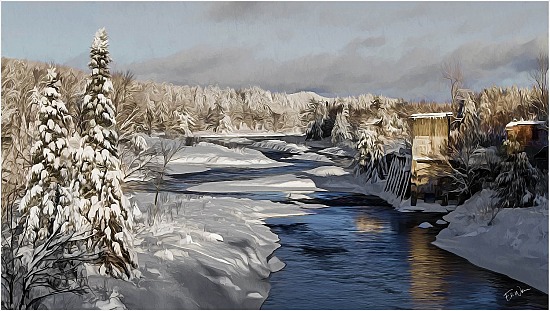
Later, while reviewing it with ChatGPT, I received an observation about the texture in the trees and snow. The evaluation suggested that the treatment might compete with the scene.
I asked whether that judgment was influenced by the negativity surrounding photo editing.
That question changed the conversation.
The texture was certainly visible. But noticing an effect and establishing that it weakens a photograph are two different things. If I wanted a painterly image, the marks created through processing could be part of the experience I was trying to offer. Their presence alone was not evidence of a problem.
The evaluation needed to explain what those marks interfered with. Did they obscure the river’s course? Did they make the important relationships harder to see? Or did they help give the photograph its character?
That distinction mattered to me.
My Vision allows the photograph to move toward what I want to create. The camera gives me something to begin with, and the finished image may take a different form. I still want to judge that image honestly. An intended effect can succeed or fail. The useful question is what it contributes to the experience.
As we continued, I realized that the evaluation could become more useful to my development.
We had begun using seven dimensions to look at composition, each assessed from one to five with an explanation. These included visual hierarchy, balance, movement, relationships, framing, distractions, and staying power. There was no total score. The numbers helped identify areas worth discussing.
But I wanted more from an assessment of three or below. I wanted a recommendation that respected my Vision and gave me something concrete to consider.
A three means that something is working. There may be an opportunity to strengthen it, or a good reason to preserve it. A useful recommendation would explain the limitation, suggest a comparison, and identify what I might gain or lose.
In the next photograph, two loons occupied a small part of a broad, pale field. The evaluation questioned whether the extensive space above them contributed enough. A possible comparison was to reduce some of that space while preserving the pale treatment and room ahead of their bills.
That gave me something to explore. A tighter frame might concentrate the relationship between the birds. The original might preserve a sense of expansiveness that mattered more. At that point, we had proposed a comparison; I had not yet tested it.
This is the kind of conversation I want to continue.
Another set of eyes can notice something I have overlooked. My response can also reveal an assumption behind the advice. I can try a change, return to the original, or discover more clearly why I want to keep what I made.
The decision remains mine. The conversation helps me make it with greater awareness.
That is where Learning To See begins.
In this series, I will share selected moments when looking again leads to a useful discovery: a recommendation worth exploring, a judgment worth questioning, or a choice that becomes clearer through comparison.
Some photographs may change. Others may remain as they are. Either outcome can teach me something.
I hope these conversations give you another reason to return to the photographs, too. You may notice something different from what either of us noticed.
There is room for that.

Leave A Comment
What stayed with you—a thought, a feeling, or a question? I invite you to share your reflections below.
Your email address will not be published or shared.
Thank you for adding your voice to the conversation. Your thoughts are welcome and appreciated. Your comment will appear here once I’ve reviewed it.
Comments