

Why I began returning to these photographs and putting words beside them.
When I began rebuilding The Work, I knew I wanted the photographs to be more than a collection of images on a website.
I wanted there to be something of me there too.
Not an explanation of each photograph. Not a story telling someone what they were supposed to see. Just enough to open another door into the image.
That turned out to be much harder than I expected.
My philosophy as a photographer has long been centered on a simple idea:
Creating images about, not of; creating questions, not understandings; seeking contemplation, not interpretation.
If I believed that about the photographs, the words beside them had to respect it too.
Three Questions
The process began with three questions.
What made me stop?
What did I see?
What did I want to create?
They sound simple. Sometimes the answers are.
Other times, the most truthful answer to the first question is simply, I don't know. Something made me look.
That became important very early.
I didn't want to manufacture an explanation years after making a photograph just because I thought one ought to exist. The questions weren't meant to create a better story. They were meant to help me return to the experience of making the photograph.
And sometimes what I understand about an image today isn't what I understood when I made it.
That is allowed too.
Looking Before Writing
At first, it seemed natural to move from those questions into titles and captions.
But something was missing.
Before asking what words belonged beside a photograph, I needed to ask whether the photograph itself was doing what I thought it was doing.
Composition became an important part of the process.
Where does my eye enter?
Where does it travel?
What holds it?
What competes for attention?
Does the photograph create the experience I remember, or am I depending on the words to make that experience happen?
One photograph made that lesson particularly clear.
It was a composite containing a loon, moon, water and island. The ingredients were things I cared about, and my intention was peaceful. But when we looked closely at the composition, there were competing visual anchors and no clear hierarchy.
The photograph did not create the quiet experience I wanted it to create.
No title or caption could fix that.
That led to one of the most important additions to the process:
Does this photograph add something worth preserving in The Work?
Sometimes the answer can be no.
A photograph can still teach me something without belonging in the collection.
Finding the Title
We also learned that title and caption couldn't be developed as three unrelated possibilities.
Originally, it was easy to imagine different titles leading toward different kinds of captions. But that meant I wasn't really evaluating the writing. I was evaluating three different interpretations of the photograph.
So the process changed.
First, settle the title.
Then leave the title alone and explore three different ways of standing beside the same photograph.
I came to call those directions Personal, Contemplative and Open.
Personal stays closest to my experience.
Contemplative moves outward toward a broader thought suggested by the photograph.
Open says less and leaves more space for the viewer.
None is supposed to be the better or more artistic choice.
That was another lesson.
For a while, there was a tendency to see the Personal caption as somehow less thoughtful than the Contemplative one. I came to realize that was wrong. My personal response is where every one of these photographs begins. Sometimes staying close to that response is exactly what the image needs.
Return became one of those reminders. More explanation did not make it stronger. Once I recognized what I had been responding to in the photograph, there wasn't any reason to keep talking.
Sometimes recognition is the end of the writing process.
When a Title Leaves Room
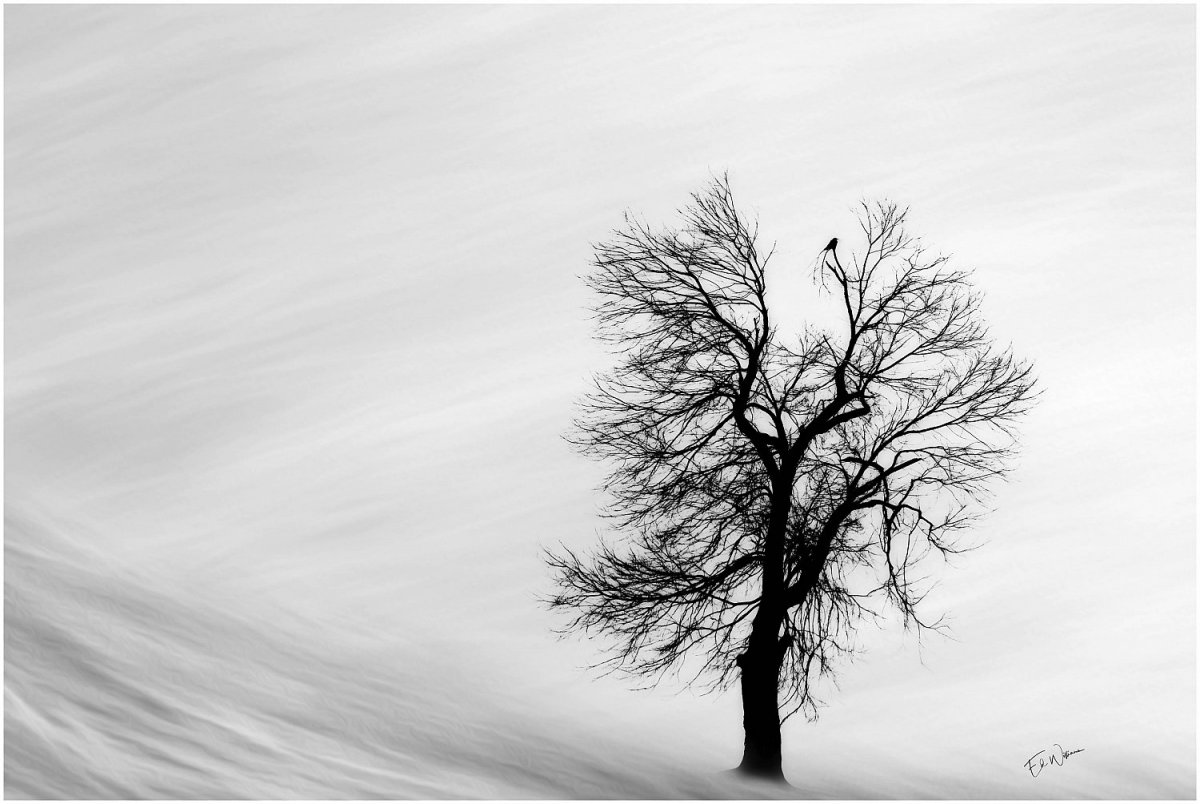
Unmoved taught me something different.
The photograph contains a relationship between movement and stillness, light and darkness. A crow arrived unexpectedly and became part of that relationship.
An earlier title, Still Point, described the idea.
Unmoved did something different.
It implied the idea without finishing it.
That distinction has become increasingly important to me. A title can point toward a photograph without declaring what the photograph means.
The words should return you to the image.
Not replace it.
Not Every Photograph Wants to Be Serious
Parallel Play was another useful correction.
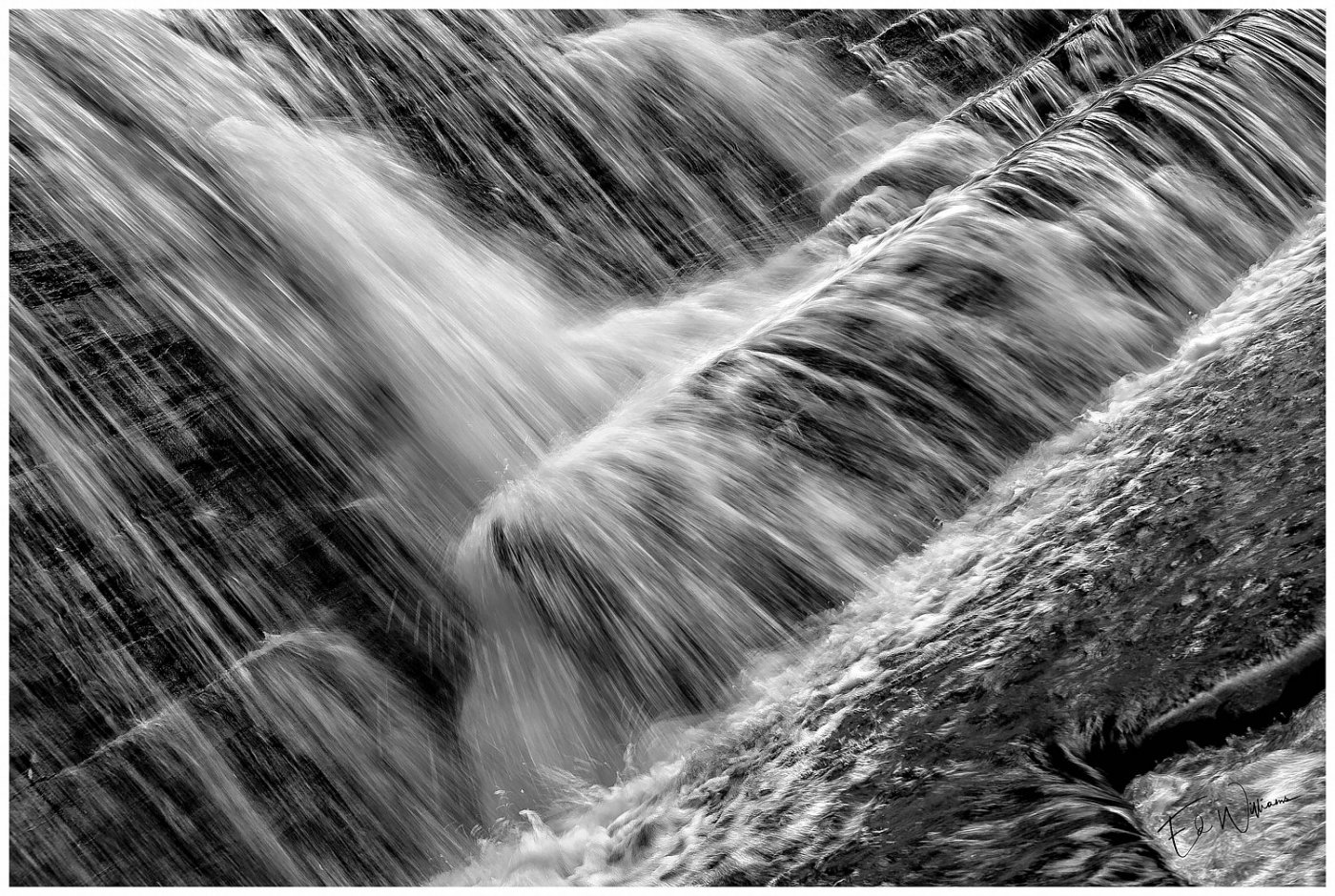
The temptation when writing about photographs is to make everything mean something larger.
But when I made that photograph, I had noticed parallel lines in the falling water and wanted to do something fun with them.
That was enough.
The process had to leave room for play, curiosity and visual experimentation as well as solitude, uncertainty and contemplation.
Otherwise, I would simply be imposing a philosophy on photographs instead of discovering whether that philosophy was already present in them.
That eventually led to another question before writing the title:
Does this photograph naturally express something of the philosophy behind The Work? If so, how?
The important word is naturally.
Not every photograph has to prove something I believe.
The Final Review
Eventually I discovered that finishing the caption wasn't actually the end.
Once the photograph was published on its page, I needed to look again.
Title.
Caption.
Photograph.
Keywords.
All together.
The final review became a separate part of the process because the finished page sometimes revealed things the working conversation didn't.
Did the title and caption still leave enough room?
Did the composition hold up at the size and presentation the viewer would actually encounter?
Did the keywords describe how the photograph belonged in The Work, or had they simply become a list of things visible in the picture?
That last question changed considerably too.
I no longer want keywords to name everything in a photograph. A photograph containing an animal doesn't automatically need the animal's name as a keyword. A photograph made in the Adirondacks doesn't automatically belong to the Adirondacks body of work.
The keyword should help describe where the photograph belongs or how it functions.
Even classification became another way of looking.
A photograph can contain trees and still function as an abstract.
A photograph can contain an owl while being as much about snowfall, space and environment as it is about wildlife.
What I Have Learned
This began as caption writing.
It has become something else.
Returning to the photographs has shown me things I didn't always consciously understand when I made them.
Sometimes I discover that the composition knew something before I did.
Sometimes the title changes how I understand the photograph.
Sometimes a few words are helpful.
Sometimes almost none are.
And sometimes the most important decision is to leave a photograph out.
The process continues to evolve because the photographs continue to teach me how I see.
The goal has remained surprisingly simple.
I don't want the words to tell you what I saw.
I want them to give you another reason to look.