
Once I decide that what the camera records is only the beginning, I also accept the possibility of going too far.
I have said that my vision is not simply to reproduce the scene in front of me.
The camera gives me a starting point.
What I am trying to create may already be forming in my mind before I press the shutter. Sometimes the choices I make with the camera begin moving the photograph toward that visualization. Sometimes much of that work comes later.
That freedom is important to me.
But it carries risk.
The moment I give myself permission to move beyond what the camera recorded, I also give myself permission to make the photograph worse.
I can lose what made me stop in the first place.
I can become more interested in what the tools allow me to do than in the photograph I was trying to make.
I can keep working after the photograph is already finished.
And I can create something that another person no longer accepts as photography.
Those risks are part of the way I work.
I don't think the answer is to avoid them.
I think the question is how to recognize them.
The Risk Can Begin With the Camera
It would be easy to think of this as a question about Photoshop.
It isn't.
Sometimes the first risk is taken before the photograph has even been made.
With Winter Script, I wasn't looking at the scene only for what it was. The snow, branches, lines, and tonal relationships suggested something else to me—something more graphic and less literal.
Winter Script
Winter can make the landscape visible in ways the other seasons cannot.
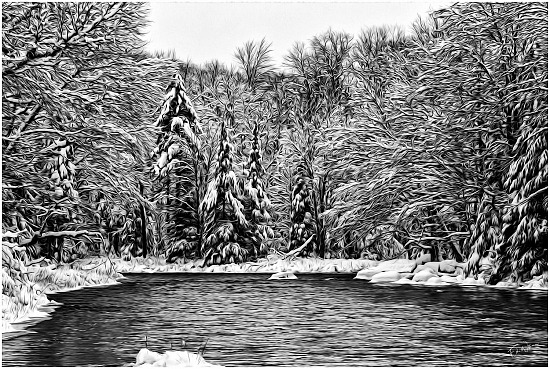
The possibility of the finished photograph was already beginning to separate from the scene in front of me.
That meant accepting a risk.
If I followed what I was visualizing, I might create something stronger than a straightforward record of the winter landscape.
Or I might simply ruin it.
That uncertainty matters.
If I already know exactly what the result will be, I am probably repeating something I already know how to do.
Risk enters when I see the possibility of something that isn't quite there yet.
What Am I Moving Toward?
This may be where my photographic vision matters most.
The question is not simply:
What can I do to this photograph?
It is:
What was the photograph I was trying to make?
Those are very different questions.
Photoshop makes the first one almost limitless.
I can change color, contrast, tone, texture, relationships, emphasis, and atmosphere. I can remove things. I can add things. I can combine photographs. I can make the result increasingly realistic or increasingly abstract.
But having the ability to change something does not give me a reason to change it.
The reason has to come from somewhere else.
It has to come from what I am trying to create.
When Beauty Is Only the Beginning
Skin Deep presents a different kind of risk.
Skin Deep
I began with something beautiful. By the time I finished, that was only the surface.
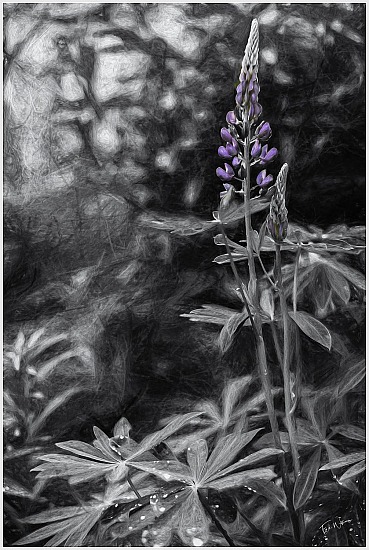
I began with something beautiful.
But beauty wasn't where I wanted the photograph to end.
As I worked, the recognizable subject became less important than form, color, texture, and the experience I believed was inside it.
The photograph moved farther away from description.
That is risky in another way.
A viewer might prefer the original beauty.
Someone might look at the finished photograph and believe I had taken the processing too far.
And they might be right—for them.
But stopping earlier merely because the image remained more conventionally photographic would create another problem.
I would be allowing someone else's expectation of what a photograph should look like to determine where my photograph should stop.
That is also a risk.
There is a temptation to treat restraint as though it is always more honest or more artistic.
I don't believe that.
Sometimes restraint is exactly what a photograph needs.
Sometimes restraint is fear.
The challenge is knowing the difference.
Too Far — or Not Far Enough?
For a long time, discussions about editing photographs have often seemed to circle around one question:
How much is too much?
I'm beginning to think that may be the wrong question.
A photograph can contain very little editing and still fail to become what I intended.
Another can be transformed substantially and remain completely faithful to the image I visualized.
The number of layers doesn't tell me.
The amount of manipulation doesn't tell me.
The amount of time spent working on it doesn't tell me.
Perhaps the better question is:
Is this decision moving me closer to the photograph I was trying to make—or farther away from it?
That makes the process more demanding, not less.
If I choose to move beyond what the camera recorded, then every significant change becomes my responsibility.
I cannot simply say that something is acceptable because it is art.
I still have to decide whether it belongs.
When the Photograph Is Constructed
Quiet Morning pushes the question farther.
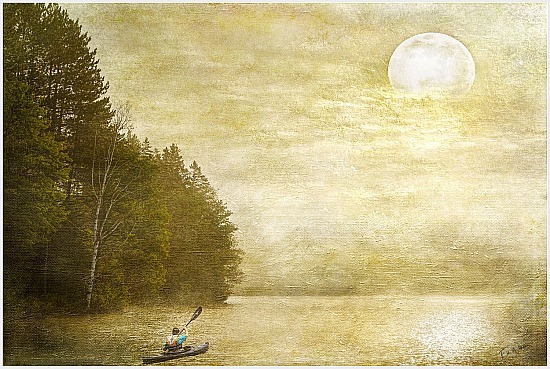
The fog, water, reflected light, and distant trees began with a photographed landscape.
The finished image also contains elements that were introduced later.
At that point, I am no longer simply adjusting what the camera recorded.
I am constructing.
For some viewers, that crosses a line.
I understand that.
There are forms of photography where the relationship between the photograph and the factual moment is essential. A documentary or journalistic photograph makes a very different promise to its viewer.
That isn't the promise I am making.
I am not asking the photograph to serve as evidence of exactly what stood before the camera at one instant in time.
I am trying to create the image I visualized.
That does not remove the responsibility to be honest about what I am doing.
If I create a composite, I see no reason to pretend that I didn't.
But neither do I believe I need to apologize for it.
The camera supplied some of the material.
I continued making the photograph.
Quiet Morning
I wasn't sure what the photograph would become. I only knew there was something in that morning I wanted to keep.
Will Everyone Still Call It Photography?
Probably not.
That may be another risk I have to accept.
Photography has wrestled with this question for a very long time. Long before digital cameras and Photoshop, photographers altered negatives and prints, combined images, softened detail, manipulated tone, and used photographic processes to move their work away from straightforward representation.
Others believed photography should remain faithful to what the camera saw.
That argument never really disappeared.
The tools changed.
The disagreement remained.
I don't expect to resolve it.
And I don't think I need to.
What matters more to me is being clear about what I am trying to do.
That may be one reason the words Visual Arts Photography became increasingly important to me.
Photography is where the work begins.
It does not necessarily define where it has to end.
Some people may see that freedom as possibility.
Others may see it as leaving photography behind.
I have to be willing to accept both reactions.
If I make my decisions primarily to avoid rejection, then the viewer has begun making the photograph before they have even seen it.
There Is Another Kind of Failure
Creative freedom does not mean that every experiment deserves to survive.
There have been photographs where I had the ingredients, the techniques, and an idea—and the finished image still didn't work.
Sometimes more editing did not bring the photograph closer.
It simply added more editing.
That may be one of the hardest moments to recognize.
The hours invested do not make the photograph better.
The complexity of the process does not make it more important.
And processing cannot rescue a photograph simply because I want it to succeed.
Sometimes the most important decision is to stop working on it.
Sometimes the decision is to let it go.
That, too, is part of making photographs.
Knowing When to Stop
I wish there were a setting, histogram, layer count, or rule that could tell me when a photograph is finished.
There isn't.
The decision remains subjective.
I can step away.
I can return later.
I can compare where I began with where I arrived.
I can ask whether the thing that first caught my attention is still alive in the finished work.
Most importantly, I can return to the question that began this series:
What was the photograph I was trying to make?
If I can still recognize that photograph, perhaps I am moving in the right direction.
If the processing has become more interesting than the reason I began, perhaps I have gone too far.
And if fear of what someone else might think keeps me from taking the photograph where I believe it needs to go, perhaps I haven't gone far enough.
The Risk Is Part of the Work
I don't think I want to eliminate the risk.
Without it, Winter Script might have remained a winter scene.
Skin Deep might have remained simply something beautiful.
Quiet Morning might never have become the place I imagined.
The risk comes from allowing myself to ask what the photograph could become rather than only what the camera recorded.
Sometimes I will make the wrong choice.
Sometimes I will go too far.
Sometimes I will stop too soon.
And sometimes someone looking at the finished work may decide that what I created is no longer photography.
I can live with that uncertainty.
Because the alternative would be to let the boundaries of what is expected determine what I am willing to create.
Perhaps the real question isn't:
How far is too far?
Perhaps it is:
Did I have the courage to take the photograph where I believed it needed to go—and the judgment to know when to stop?

Leave A Comment
What stayed with you—a thought, a feeling, or a question? I invite you to share your reflections below.
Your email address will not be published or shared.
Thank you for adding your voice to the conversation. Your thoughts are welcome and appreciated. Your comment will appear here once I’ve reviewed it.
Comments