

Why making a photograph begins before the shutter is released—and often continues long after the camera has recorded the scene.
The camera records what was in front of me.
But what the camera records and what I visualize are not always the same thing.
Wind
The open field, distant hedgerow, and sky immediately caught my attention. I knew what I wanted to create—not the landscape as it appeared, but the movement I saw within it.
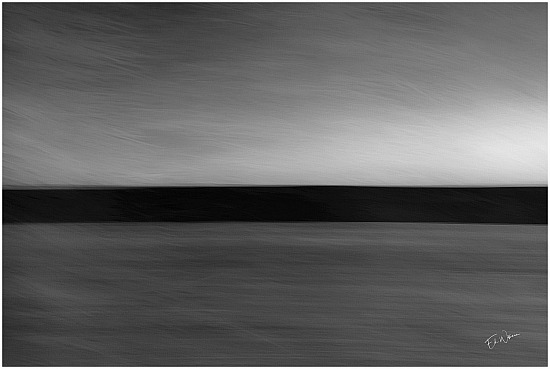
Sometimes that difference begins long before Photoshop.
It can begin with where I stand, the lens I choose, the shutter speed I use—or even with deciding that I don't want the camera to describe the scene literally at all.
Making the Photograph
The camera was the beginning.
For a long time, I probably would have described what happens afterward simply as editing.
I don't think of it that way anymore.
A photograph can begin before I ever pick up the camera.
Why did I go out that day?
Why that place?
Why did I carry one lens instead of another?
Why did I stop here rather than continue walking?
Why did I choose a particular shutter speed, aperture, or point of view?
Those choices are already becoming part of the photograph.
Then the shutter is released.
The camera records what was in front of me.
But what the camera records and what I visualize are not always the same thing.
That distinction has become increasingly important to me.
My vision has never been simply to reproduce a scene as accurately as possible. I want to begin with what is there and create the image I see in my mind.
Sometimes the distance between the two is small.
Sometimes it is considerable.
Some photographs begin moving away from a literal rendering while I am still behind the camera. Others remain close to the original capture and need little more than a tonal adjustment. And some continue through changes in color, light, contrast, cropping, layers, masks, or more substantial transformations.
At times the finished image may feel closer to a painting than what we traditionally think of as a photograph.
That is not an attempt to make photography become painting.
It is an attempt to use photography to create what I visualized.
Perhaps that is why, somewhere along the way, Ed Williams Photography no longer seemed quite large enough to describe what I was doing.
It became Ed Williams Visual Arts Photography.
And eventually, EW Visual Arts.
The Camera Was the Beginning
One part of this series will look at the decisions surrounding the original exposure.
Not simply what camera I used or what the settings were.
Those things are easy enough to list.
I am more interested in why they mattered.
Why did I choose that lens?
Why one second instead of 1/125 of a second?
Why did I use a tripod?
Why did I move closer—or farther away?
Why was I there in the first place?
The technical information can tell us what I did.
The more interesting question is why I did it.
Before the Photograph Was Finished
Another part of the series will begin with what the camera gave me and follow the photograph from there.
Many of my photographs were worked on in Photoshop and saved as layered TIFF files.
Those files have turned out to contain something I had not thought much about before.
They are records of decisions.
The original camera information may still be there.
So may the RAW development settings.
Photoshop layers can reveal changes in tone and color, masks, opacity, adjustments, and sometimes the different stages through which an image passed.
They cannot tell me everything.
A file may tell me that I changed the Levels.
It cannot tell me why I looked at the photograph and decided the light needed to change.
It may show that I blended another version of the image over the original.
It cannot tell me what I was trying to create when I did it.
That part has to come from me.
And sometimes I may not remember.
That, too, is part of looking back.
Vision and Philosophy
I have written elsewhere about my philosophy of photography:
Creating images about, not simply of.
Creating questions rather than answers.
Leaving room for contemplation rather than prescribing interpretation.
But I have come to realize that my philosophy and my vision are not quite the same thing.
My philosophy has much to do with the relationship between the finished work and the person looking at it.
My vision begins earlier.
It asks:
What am I trying to create from what I see?
That may be where this series becomes most interesting to me.
By going back through photographs made over many years, I may be able to see not only how my techniques changed, but how my way of seeing changed.
Perhaps the choices I made without thinking much about them at the time will reveal patterns.
Perhaps some things I thought were important will turn out not to have mattered very much.
Perhaps a complicated photograph will have a very simple story.
And perhaps a photograph that required almost no editing will tell us far more about making an image than one containing dozens of layers.
I don't know yet.
That is one of the reasons for beginning this.
Looking Back to Understand the Making
This will not be a series of Photoshop tutorials.
There will be camera settings and processing details when they help tell the story, but knowing that a Levels adjustment was set to a particular value isn't very interesting by itself.
I want to understand the decision behind it.
What was I trying to change?
What was I trying to preserve?
What was distracting me?
What was I trying to bring forward?
And, ultimately:
What was the photograph I was trying to make?
The files can help reconstruct what happened.
The finished image can show where I arrived.
Somewhere between those two is the story I want to explore.
That is Making the Photograph.


Leave A Comment
What stayed with you—a thought, a feeling, or a question? I invite you to share your reflections below.
Your email address will not be published or shared.
Thank you for adding your voice to the conversation. Your thoughts are welcome and appreciated. Your comment will appear here once I’ve reviewed it.
Comments